
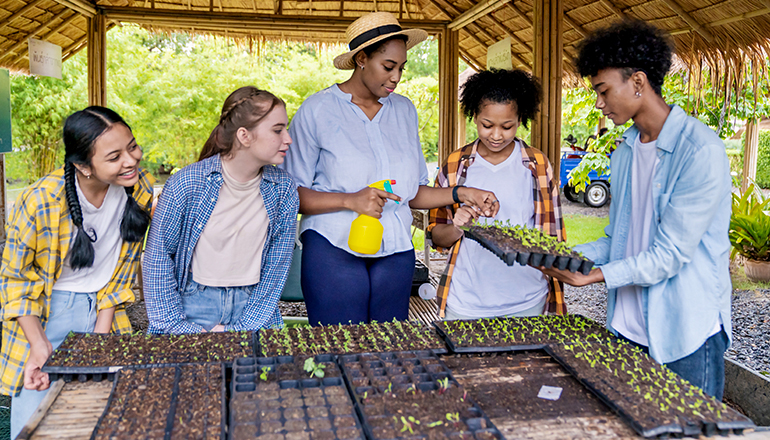
From garlic growing in school gardens to lettuce produced in hydroponic systems, students across the North Colonie School District are getting a hands-on lesson on where their food comes from. Through the district’s Farm-to-School program, gardens, classrooms, and cafeterias are being connected to bring fresh, locally grown food into students’ daily lives.
The Farm-to-School program is part of a nationwide initiative designed to increase the amount of local food served in school cafeterias while also giving students opportunities to learn about agriculture, nutrition, and sustainability. More information about the program, including its mission statement, can be found on the North Colonie School District’s Farm-to-School webpage.
At North Colonie, the program began with the creation of a garden at Shaker High School around 2017–2018. As teachers explored ways to incorporate the garden into lessons, the idea expanded into a district-wide initiative.
Amber Cost, a chemistry and food science teacher at Shaker High School who now serves as the district’s Farm-to-School coordinator, explained that the program connects “the classroom, the cafeteria, and the community through local, fresh, healthy food.” It was her desire to show students where their food comes from — and how to cook with it — that first inspired her to start the garden at Shaker.
A key partnership from the very beginning has been with Forts Ferry Farm, which helped launch the original high school garden and continues to work closely with the district’s food service department. Without that initial collaboration, Cost says, much of what the program has become would not have been possible. Hillard’s Greenhouse, a local, family-owned business in Colonie with ties to the district, has also played an important role, helping construct the garden at Southgate Elementary and supplying plants and produce.
Today, gardens are located at every school in the district. At Shaker High School, the garden sits in the courtyard, while other schools have gardens near entrances, playgrounds, or outdoor courtyards. Blue Creek Elementary has one of the largest gardens, and Forts Ferry and Southgate recently added new gardens last year. Plans are also underway to add growing spaces at the Goodrich building, which houses the district’s special education young adult transition program for students ages 19 to 22.
Students grow a wide variety of foods across the district’s gardens. Common crops include tomatoes, cucumbers, lettuce, kale, potatoes, onions, and herbs. This year, garlic is being grown in every school garden after students planted it in the fall. Some schools are also experimenting with fruit production, including apple trees at the high school and an orchard at Blue Creek.
Flowers are also planted in many of the gardens — not for food, but to attract pollinators such as bees and butterflies while helping students learn about ecosystems.
In the cafeteria, the program is visible through initiatives like “New York Thursdays,” where the food service department features as many New York State products as possible, and a monthly “Harvest of the Month” spotlight. Each month, a locally grown or produced item is chosen, a recipe is developed around it, and students are invited to try it before it appears in the cafeteria line.
In addition to traditional gardens, the program is expanding into hydroponics, which allows plants to grow in water rather than soil. At Shaker Middle School, a large hydroponic system called a Fork Farm can grow about 40 pounds of lettuce in roughly six weeks, producing enough greens to make salads for students.
Even with these gardens, the goal is not to grow enough food to supply the entire district. Instead, the gardens help introduce students to fresh foods while supplementing cafeteria ingredients and providing hands-on learning opportunities.
Students are involved in many parts of the program. Athletic teams often help maintain the gardens, while members of the Environmental Club assist with planting and harvesting. Some students have even worked as paid summer interns helping care for the gardens.
Special education programs are also closely involved. Students in the district’s Extended School Year program help harvest crops, prepare produce for community markets, and create signs for garden events. Recently, the hydroponic system at the middle school became a job training site for special education students.
The food grown in the gardens is used in several ways. Some produce is incorporated into cafeteria meals or used in cooking classes. Herbs are sometimes dried and used later in recipes. Extra food is also shared with the community through summer garden markets, where residents can take produce for free or make donations that support the program. The district has also begun contributing some of the harvest to backpack food programs at each of its buildings.
Beyond growing food, the program aims to build a stronger sense of community within the district.
“It’s about learning where our food comes from and bringing people together around food,” Cost said. “Students can work toward a common goal while learning about nutrition, health, and the environment.”
Looking ahead, Cost hopes the program will continue to expand so that every student in the district — from kindergarten through the transition program — can participate.
“I want the program to be sustainable and far-reaching,” Cost said. “There are so many rewarding moments in this program. If it can impact every student and strengthen our community, then we’re doing something really meaningful.”