
Introduction
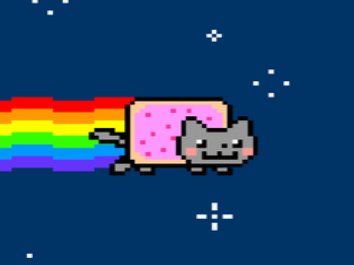
Nyan Cat. Skibidi Toilet. Harambe. Although greatly different in subject matter, these three concepts fall under one umbrella: they’re all memes. An everpresent fixture of how people convey information to each other, memes are widely associated with the internet age– from the primeval text over image prototypes to the more refined, video formats they take in the modern day.
Despite their often lighthearted, humorous nature, memes have had a surprisingly interesting history ever since the word’s introduction in 1976. This article will explore what memes are, how they’ve been used in popular media and a particularly maligned variety of memes common nowadays.
What is a Meme?
Intuitive to the subject of this article, you would be somewhat right to assume that memes are simply funny images people send each other on the internet. However, memes hold a much more expansive and complex meaning than just humor.
Meme is an abbreviation of mimeme, first coined in Richard Dawkin’s The Selfish Gene. In its original context, memes are a cultural unit of information that is spread through imitation. You may notice through my wording that “memes” parallel “genes”; this is wholly intentional, as memes are a cultural equivalent of genes. Like genes, memes compete with each other, mutate at random (people tend not to perfectly imitate someone else’s idea), and can be passed down from generation to generation. Moreover, while “fit” memes spread, ideas less adapted will eventually become defunct.
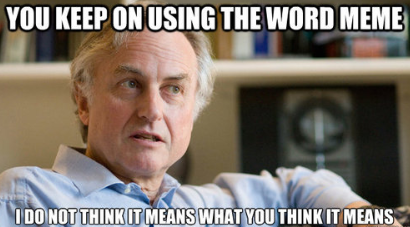
Richard Dawkins, now ironically the subject of a meme himself.
An example of these principles in action would be “The Dr. Livesey Phonk Walk” meme. Originating as the phonk song “Why Not” set over a clip of the 1988 Soviet adaptation of Treasure Island, this meme gained popularity following its creation on July 23rd, 2022. This is likely due to the rather comical manner Dr. Livesey walks, in addition to his muscular frame.
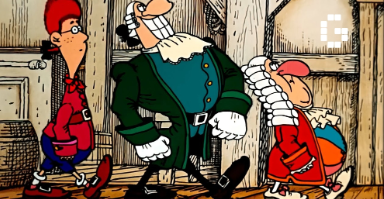
The Dr. Livesey Phonk Walk meme.
As with any popular meme, the creation of this meme spawned several offshoots, leaping from brain to brain to spread like a virus. This meme fittingly became “viral” for some time, inspiring people to put their minds to work creating their own takes on this idea. However, this meme’s popularity faded, and although it still exists today, it is no longer a dominant presence on the internet.
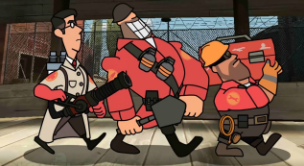
A variation of the Dr. Livesey Phonk Walk meme. The characters used here originate from Team Fortress 2(2007), a popular multiplayer strategy game. The Dr.Livesey analogue is the soldier (middle).
With the original definition of meme taken into account, humans have been making and spreading memes long before the internet. New ideas, ways of making certain products, and even fashion trends all qualify as memes. In fact, one could argue that memes have been critical to the survival of humans as a species, with memes like “how to make fire”, or “where to forage for food in the forest”, or even “how to make a particular kind of shirt”.
Memes are not exclusive to people either. For instance, in 1965, a team of primatologists researching a group of Japanese macaques in Japan’s Koshima Islet observed one female macaque rinsing her sweet potato clean. This was far faster and more efficient than her peers meticulously picking out every grain of sand and dirt from their food. Monkey see, monkey do, and this behaviour consequently spread amongst her group, even extending to other monkeys on the island. This may underpin an evolutionary advantage of memes: if an individual discovers an advantageous behavior, this will be spread widely through imitation, increasing the species’s chances of survival.
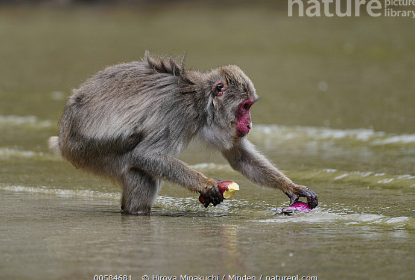
Macaque washing a sweet potato.
Memes in the Media
One of the few multimedia franchises to use the original definition of meme, the Metal Gear franchise has had a long and detailed history with memes.
As confirmed by the series creator, Hideo Kojima, the major theme of Metal Gear Solid 2(2001) is memes and their effect on society. Its predictions of a future where truth is shrouded by an unstoppable flow of AI-directed, irrelevant information are almost prophetic some 23 years later. In the game, the Patriots — an illuminati like secret society which aims to create world peace — creates an AI-directed cybernetic system, utilizing information control to keep only the memes they desire, while ones they dislike are purged from the collective consciousness of the masses. In game, this is reflected by the player being constantly misdirected, forced to question if their own perceptions of reality are accurate, or if they too have been strung around by the Patriots. One could argue that the entire game itself is a meme; it is just the ideas and information of Kojima that has been passed down to the player’s mind
Future titles have kept this theme as well. In Metal Gear Rising:Revengeance(2013), this is most apparent with the villain Monsoon. Prone to wax poetic regarding his determinist views, Monsoon is highly nihilistic and misanthropic to the point where he believes that free will does not exist. Rather, we are but puppets to the influence of memes. They are our culture, they are “the dna of the soul”. In a way, he is right. The ideas passed down from generation to generation can have an iron-strong hold on how people think and act after all.
As Monsoon says, “Expose someone to anger long enough, they will learn to hate. They become a carrier.”. In addition to referring to himself with that line, this is reflective of how memes have been used to radicalize people to extreme, black and white ideologies. However, Monsoon’s monologues has applicability to more mundane memes as well. Is tradition not but a set of cherished, yet admittedly archaic memes?
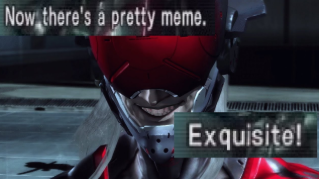
A meme of Monsoon. The text above is his in-game dialogue.
Monsoon himself has been subject to the influence of memes, as he shares similarities with Metal Gear Solid’s(1998) Psycho Mantis, particularly their determinist views. Uniquely, this is also directly represented during Psycho Mantis’s fight. Since he is a master of clairvoyance, he can “predict” all of the player’s actions during his fight, confirming his ideology in the process. In addition, he is also psychokinetic, and is even capable of “moving” the player’s playstation controller. This makes Psycho Mantis a difficult opponent to overcome as well.
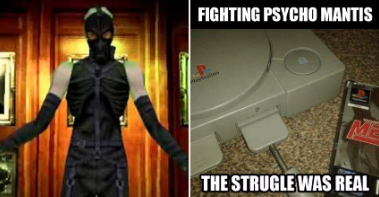
An old internet meme regarding Psycho Mantis’s infamously tricky fight.
It Just Keeps Tumbling Down: Birth of Brainrot
Bane of many an internet user, brainrot is typically defined as the mental and intellectual decline of a person resulting from overconsuming low-quality content, often called brainrot as well. Such content is typically characterized as repetitive, unchallenging, and “low effort” content. Symptoms of brainrot include low attention span, mental fogginess, and decreased ability to engage in higher thought. Using the prior framework of “memes=genes”, brainrot is most analogous to a blend of an aggressive cancer and prions. Like cancer, they spread rapidly, and like the misfolded proteins, brainrot is near indestructible. Like how a prion can create other prions through proximity, brainrot can arguably be described to spread in a similar manner, leaping from mind to mind. In this light, brainrot is somewhat parasitic in nature, seldom wanted, rather invading uninvited. It is worth noting that the term “brainrot” is a value judgement as well, and is inherently subjective as a result. Anecdotally, it is not uncommon for older generations to call the younger generation’s newest memes “brainrot” as a way to denigrate them.
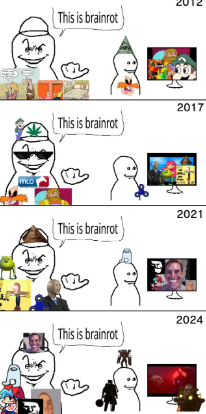
A meme illustrating the subjective nature of brainrot.
Conclusion
The path ahead is currently uncertain for memes as a whole. Internet memes in particular are extensions of whatever is currently trending in popular culture, and as a result, predicting what future memes will be with any real accuracy is inherently difficult. For instance, in 2022, it was believed by some that memes would eventually transition to become NFTS(non fungible tokens) and be sold by their creators. However, this hubris was rather quickly snuffed out with the rapid decline of the relevance of NFT’s on the internet. It appears that memes, much like the evolution of life on this planet, is an unpredictable and is hugely diverse, unable to be controlled fully by man. No matter what, one could suppose that much like life, memes will find a way.
Sources
https://www.newportinstitute.com/resources/co-occurring-disorders/brain-rot/
https://www.nytimes.com/2022/01/26/crosswords/what-is-a-meme.html
https://en.wiktionary.org/wiki/meme
https://www.nytimes.com/2022/01/26/crosswords/what-is-a-meme.html
https://www.youtube.com/watch?v=c8LHpoNTaF0
https://www.nbcnews.com/health/health-news/how-deadly-prions-are-destroyed-flna1c9475896
https://alraziuni.edu.ye/uploads/pdf/The-Selfish-Gene-R.-Dawkins-1976-WW-.pdf
https://www.hopkinsmedicine.org/health/conditions-and-diseases/prion-diseases?scrlybrkr=d9896532
https://pmc.ncbi.nlm.nih.gov/articles/PMC4626585/
https://www.youtube.com/watch?v=MH_4dqNjCE0
https://www.youtube.com/watch?v=UGRCf4WZWoE
https://tvtropes.org/pmwiki/pmwiki.php/Characters/TreasureIsland1988
https://knowyourmeme.com/memes/dr-livesey-walk
https://www.pbs.org/independentlens/blog/from-kilroy-to-pepe-a-brief-history-of-memes/
https://www.bbc.com/future/article/20220928-the-surprising-power-of-internet-memes
https://corp.oup.com/news/brain-rot-named-oxford-word-of-the-year-2024/
https://www.heart.org/en/news/2025/05/27/is-brain-rot-real-heres-what-brain-health-experts-say
https://www.metagearsolid.org/reports_legacyofmgs2_2.html
https://www.pbs.org/independentlens/blog/from-kilroy-to-pepe-a-brief-history-of-memes/
https://www.reddit.com/r/shitposting/comments/1dd34qv/the_brainrot_cycle/