
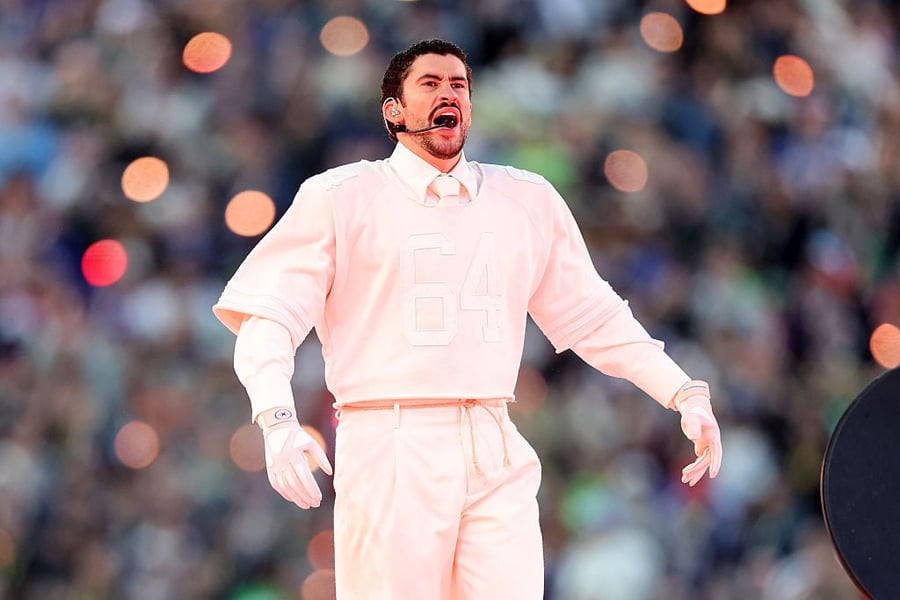
Halftime is a monumental part of the National Football League’s biggest game of the year: the Super Bowl. Every year, a highly influential artist is chosen to perform during the halftime break, and it’s annually considered one of the most significant entertainment performances of the year. This year, however, the selection of the anticipated performer was met with enormous pushback, even receiving criticism from the President of the United States. What was it about Bad Bunny, a Puerto Rican Grammy Award winning singer, that sparked so much backlash? Whether it was the performance itself or something deeper, such as his ethnicity, it clearly has had a major impact on media opinion surrounding the event.
Benito Antonio Martínez Ocasio, more famously known as Bad Bunny, is a global Puerto Rican artist specializing in reggaetón and Latin trap music. His achievements over the years have been remarkable, from being Spotify’s most-streamed artist for three consecutive years, to becoming the first Spanish-language artist nominated for a Grammy in the Album, Record, and Song of the Year categories. He has won six Grammys, seventeen Latin Grammys, and eight Billboard Music Awards. Given these accomplishments, the backlash claiming he was not well known enough to perform at the halftime show seems highly unrealistic. However, the image Bad Bunny portrays to the public has not been well received from a conservative perspective.
A common criticism has been that his performance was meant to mock Donald Trump, especially considering that his music videos, such as “NUEVAYoL,” feature pro-immigrant themes and anti-ICE symbolism. Another claim was that he is not an American citizen and therefore should not represent the United States in one of the biggest performances of the year. This criticism is not correct and rooted in stereotypes and misinformation. Puerto Rico is a U.S. territory making Bad Bunny a U.S. citizen. He has also been outspoken about his concerns regarding touring in the United States amid increased immigration enforcement. He stated, “There were many reasons why I didn’t show up in the U.S., and none of them were out of hate… But there was the issue of ICE being outside my concert.” He reinforced this message during his Grammy Awards acceptance speech, stating, “We’re not savages, we’re not animals, we’re not aliens. We are humans and we are Americans. The hate gets more power with more hate.”
During his performance, Bad Bunny proudly represented his homeland of Puerto Rico and other Spanish-speaking nations while displaying the message “The only thing stronger than hate is love” on the jumbotron for millions to see. He performed almost entirely in Spanish, first introducing himself by his birth name to emphasize that embracing who you are can take you to the biggest stages in the world. One of the few times he spoke English was when he said, “God bless America,” before listing Latin American countries from Puerto Rico to Cuba and ending with the United States, and Puerto Rico once again. This moment conveyed that Latin America is an integral part of the American story and should not be viewed as separate or lesser. Dancers carried flags representing nations across the Americas, symbolizing that this continent is united through its diverse cultures and people.