
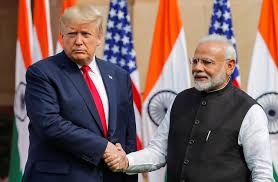
On February 2, 2026, U.S. President Donald Trump and Indian Prime Minister Narendra Modi announced a new trade agreement that seeks to end a year-long mounting of economic tensions between the two countries. At its heart, the deal marks a pragmatic reset of bilateral commerce that reflects shifting geopolitical priorities as well as economic interests.
Under the agreement, the U.S. will reduce its tariff on Indian goods to about 18 percent, reversing punitive levies that were raised as high as 50 percent amid trade tensions over energy imports and tariff reciprocity. The agreement also rescinded the extra 25 percent penalty tied to India’s purchase of discounted Russian crude. In exchange, India has agreed to lower trade barriers on U.S. exports and end purchases of Russian oil. By doing so, India would be pivoting toward American and potentially Venezuelan oil supplies. Indian leaders have welcomed the outcome, framing it as a renewed opportunity for Indian industry to expand its economic reach.
This deal comes against a backdrop of broader trade realignment and diplomatic tension. Throughout 2025, U.S. – India relations were strained by a sharp rise in tariffs imposed by Washington in response to India’s energy strategy amid the Russia-Ukraine war. Those measures became one of the most severe tariff spikes against any major trading partner, creating uncertainty for exporters in the textiles, pharmaceuticals, and machinery sectors.
The new agreement effectively stabilizes the countries’ trajectories by putting tariff levels closer to global norms. Analysts suggest this will boost India’s export competitiveness and help restore investor confidence that had waned during the period of punitive trade measures. Early market reactions have been positive, with Indian equities and the rupee value strengthening.
From a strategic perspective, the timing is notable. New Delhi recently closed a substantial trade pact with the European Union, signaling that India is pursuing a diversified trade strategy, in a broader recalibration of India’s place in global trade networks.
While the announcement outlines the overall contours of compromise on tariffs and energy,many details have yet to be formalized. Specific timetables, enforcement mechanisms, and sectoral commitments remained to be spelled out through ongoing negotiations.
Sources:
https://www.reuters.com/world/india/trump-says-agreed-trade-deal-with-india-2026-02-02/
https://www.atlanticcouncil.org/dispatches/what-to-know-about-the-us-india-trade-deal/